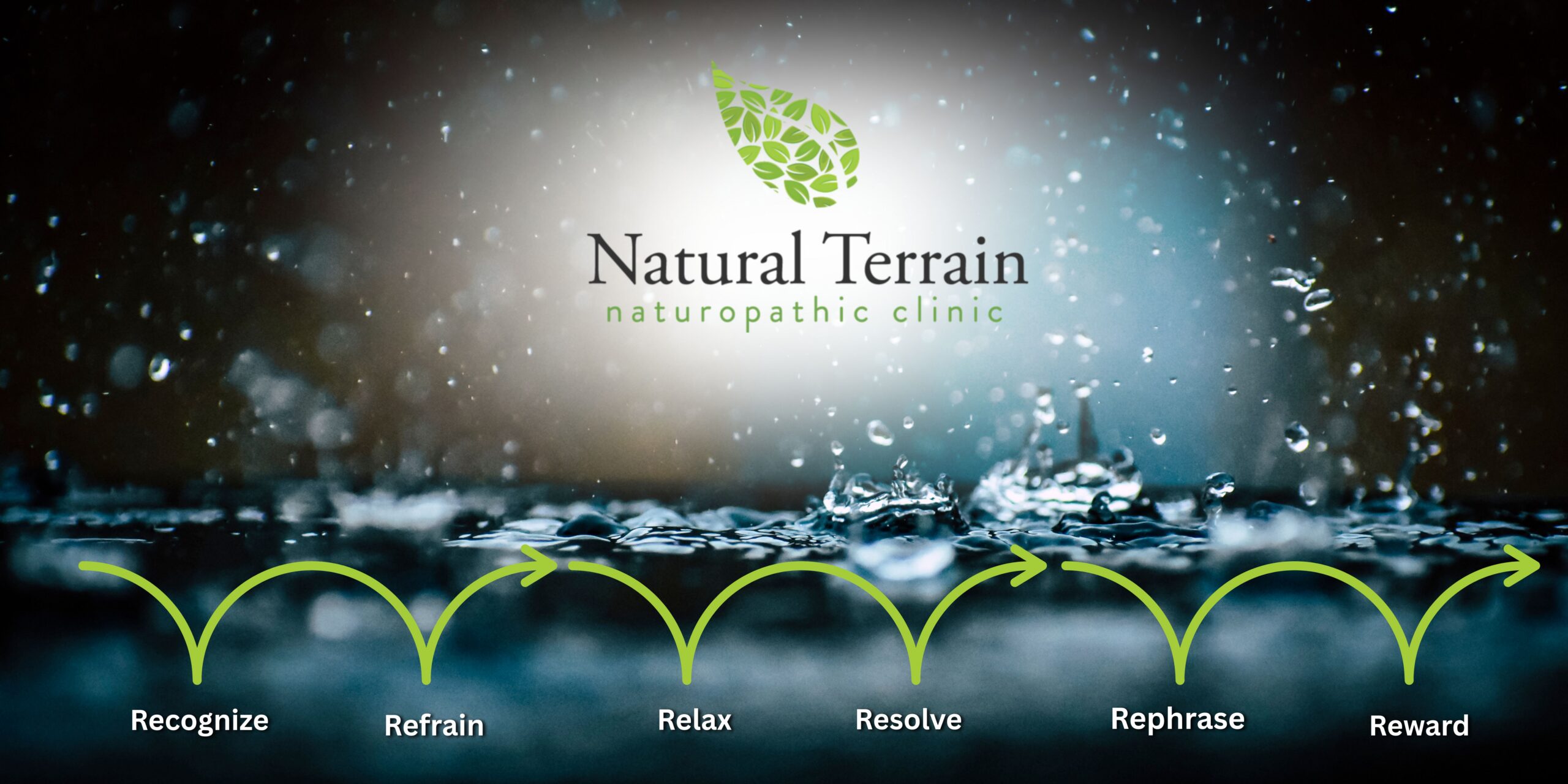
The 6 “R’s” of Working with Problematic Thought Patterns

Thought patterns can get us into lots of trouble!  They can have a tremendous “stickiness” that gets our minds “stuck” around certain issues, beliefs or concepts. Once our minds are “stuck” we humans feel a tremendous “urge” to follow these thought patterns… which often times, doesn’t lead anywhere good. This is an overview of working with this “sticky” quality of our minds, and freeing ourselves of the “urge” to follow destructive patterns.

1. Recognizing 

  • Recognize that you are stuck!!
  • The 1st and most important step.
  • A useful quote that can help us out here is… “the emotions are our bodies reaction to thought”
  •  Chances are that if you are feeling strong emotions, you are probably “stuck” somewhere.


2. Refraining

  • Refrain from following the “urge” to follow destructive thinking patterns.
  • I find it useful to do something other than the usual response here…
  • If you know “The Work” then this would be a great time to do it!
  • By refraining we train ourselves to adapt and respond more appropriately to life


3. Relaxing

  •  Once we refrain from our habitual “urge” to follow, we may find that the feeling of being stuck is still there… this is normal.
  • Relax into the feeling of being “stuck”
  • You will find that if you can allow yourself to relax, both the feeling and the urge to follow our habitual responses dissipate and lessen!
  • I find it useful to practice a breathing exercise or grounding practice (like meditation) to allow this relaxation to occur.


4. Resolve

  • Resolve to do this process again and again!
  • Why? Because you are human, and it’s in the nature of humans to get stuck in problematic thinking patterns from time to time!
  • Don’t be harsh on yourself with this… Don’t say to yourself “Oh jeez… here I am stuck again” in a negative way when you notice that you are stuck. Rather, congratulate yourself for noticing and having the ability to see that you are stuck! This leads to the road of release.


5. Rephrase/Reaffirm:

  • Rephrase whatever the “negative” thought was that your recognized was keeping you stuck
  • Be careful how you talk to yourself because you are listening
  • Complete a “thought record” from Mind over Mood if necessary


6. Reward

  • Treat yourself kindly by rewarding yourself with a simple life pleasure, such as a massage, a nice warm bath or to curl up with a good book.
What’s In Your Water? (Filter Guide)

In 2019, the Environmental Working group, an authority on environmental health matters, released a peer-reviewed study estimating that chemical pollutants in drinking water could result in more than 100,000 cancer cases in the USA alone. Read the report here.

It’s vital to know your water is safe. You can have your drinking water tested with Doctor’s Data labs (click here for more info). Below is all you need to know about the water you drink and how to make sure it’s as clean and healthy as possible.

Do you know what’s in your water?

      • City water usually has high sodium levels
      • Soft water replaces calcium and magnesium with sodium
      • City water is chlorinated to kill bacteria
      • City water is fluorinated to prevent tooth decay, though many cities are stopping this but Edmonton continues to flouridate
      • City water may contain calcium hydroxide or other alkaline substances to change pH of water so it doesn’t corrode pipes
      • Chlorine and other additives used to treat water can react with other organic chemicals to produce toxic chlorinated hydrocarbons, chloramines including chloroform and other trihalomethanes.
      • Water pipes may contribute chemicals or metals – especially copper and lead.

What’s in a typical supply of:

Tap Water

      • Sanitation process may not clean up tap water supply of animal wastes, local fertilizers, and insecticides, and chemical wastes.
      • Tap water can also have lead, radon, nitrates, mercury, aluminum, cadmium, organic solvents, bacteria, viruses, parasites, industrial chemicals, pesticides, asbestos, chlorine, fluoride, and sodium.

Well Water

      • No sanitation process. It’s important to test well water annually.
      • May contain heavy metals, pesticides, herbicides, radon, asbestos, hydrocarbons, bacteria.

Spring Water

      • Mineral content varies widely depending on region; water from lakes, streams, and spring water from east coast and pacific north west areas are low in minerals, central North America is high minerals
      • May also be polluted – is important to test

Filtered Water

  1. Activated carbon (eg. Brita)

  • Clears bacteria, parasites, most viruses, Cl2, and heavy metals, particulate matter
  • Cannot use hot water in filter – releases contaminants
  • Not for inorganic minerals i.e. fluoride, rather it is best for removing organic chemicals and chlorine, micro-organisms and metals
  • Carbon is granulated – has direct pockets between carbon particles to trap bacteria and remove from water but bacteria may multiply, silver is used to kill bacteria
  1. Solid Carbon Block (eg. Berkey filter)

  • Traps more chemicals, organic pollutants, radon, asbestos than granulated carbon filters
  • Change regularly to avoid dumping more bacteria and chemicals into drinking water
  • Will filter 400-1,000 gallons until they need be to changed.
  1. Reverse Osmosis

  • Under pressure, water flows through special membranes with microporous holes (size of water) allowing water to pass through and reject larger molecules.
  • Removes 100% of all organic material and almost all minerals – minerals need to be added back in
  • Are energy efficient as they only require pressure from the tap water
  1. Distilled Water

  • Vaporizing water (i.e. steam) in one chamber and then condensing in the 2nd chamber, removes all minerals, organisms and chemicals
  • Should be pure water but there may be organic chemicals that evaporate along with the water
  • Similarly devoid of minerals; may need to be added back.

What do we drink at Natural Terrain?

Of all the options (tap, brita, solid carbon, well, spring, distilled, reverse osmosis), we recommend solid carbon (Berkey) and reverse osmosis.

  • Solid carbon filters (eg Berkey filter) – removes bacteria, chlorine, most chemical pollutants
  • Reverse osmosis removes nitrates and Fl, be aware of possible need to re-mineralize water

The Environmental working group has also released an updated water filter guide that helps you to understand the different types, and even helps you decide which is best for you and your water. Check out this link for the guide.


Photo by Imani on Unsplash